All posts by Bryce Ashlin-Mayo

A Common Myth

The following post was recently published in the Vermilion Standard.

We’ve embraced a myth in our culture.  It is a myth that we all wish was true.  In fact, we operate our lives and schedules around this myth in search of its illusive and tempting claim, consequently robbing ourselves of the very thing we are searching for.  This myth is called “Planned Isolated Quality Time.”

Let me explain…
In our culture, we have come to accept that the illusive and mythical reality of planned isolated quality time is possible and so we schedule our lives around creating this mythical time in our various relationships, futilely attempting to compensate for the lack of quantity time we have in our busy schedules.  I believe we accept and embrace this myth specifically because it means we can live without boundaries or margins, perceivably skipping those realities because we have scheduled quality time.

We seek this mythical quality time with our spouses, believing that if we just schedule special times where we will be together alone, it will make up for the hours spent apart through our daily routines of busyness.

We seek the mythical planned isolated quality time with our kids, believing that if we just schedule special events and holidays (planned isolated quality times), they will offset the lack of quantity time spend because of our overfilled schedules.

I want to suggest that planned isolated quality time is a myth!  My experience has always been that quality time always happens spontaneously in the midst of quantity time and is often unplanned and never isolated.  Said again, quality time does exist, it is just very difficult to plan it.  When we attempt to plan quality time, at the expense for quantity time, we end up starving those we love and ourselves from the quality time we all desperately desire and need.

I write this article with full disclosure that I am not an expert in this and am constantly learning what this means in my every day life.  I, too, am at times a believer in the myth of planned isolated quality time and am constantly (re)learning to reject this myth.

Quality time exists spontaneously within the selfless gift of quantity time.  We all desire what can only be accomplished through quantity time with those we love and those who love us.  This takes effort and self-sacrifice but it is worth it – the ones we love are worth it.  Reject the myth and accept the hard truth that time is an expensive gift worth giving and sacrificing for those we love.

Invite Christ In

The following was recently published in the Vermilion Standard.

As a pastor I have the privilege and challenge of guiding people through some very difficult situations in their lives.  If anyone ever questioned whether life is complicated, I can say, with some authority, that it is!   Life has its moments filled with difficulty, trials, challenges, mourning, grief, disappointment, rejection, confusion, etc.  This is, of course, not news to you and something each of us is intimately familiar with.   It is in these times where I am often called upon to provide guidance and direction.

Although this often seems like a daunting task, I am reminded of my role as a minister: to simply, but profoundly, invite Jesus Christ in.  My role is not to provide a simple answer, but to invite Christ in.  Through prayer and the ministry of Scripture (the Bible), I can lead the action of inviting Christ Jesus into the pain, sorrow, grief, relationship, conflict, struggle, and temptation, reminding people of the fact that God offers comfort, wisdom, peace, joy, and strength.
In your life today, what does it mean to invite Christ in?  When things feel like they are being pushed apart, what does it mean to invite Christ in?  When your marriage is falling apart and you are not sure what to do next, what does it mean to invite Christ in?  When you have no idea what to do in a situation or with a relationship, what does it mean to invite Christ in?
Sometimes this means an opening to what the Bible (God’s Word) would say in the situation.  Sometimes it means praying and verbally expressing a desire for Christ to come into the situation and give His guidance and direction.
The Bible is filled with reminders that Jesus, God, never forces his way into anyone’s life but He is always waiting to come in!  God allows us to have the free choice of participation, because love is never love when forced.
Scripture tell us that God loves extravagantly (perfectly expressed through Christ) and can do immeasurably more than we can ask or imagine.  Therefore, where do you need to invite Christ in today?  What are you waiting for?

“Now to him who is able to do immeasurably more than all we ask or imagine, according to his power that is at work within us, to him be glory in the church and in Christ Jesus throughout all generations, for ever and ever! Amen.(Ephesians 3:20-21, NIV)

Life Lessons From The Coffee Bean

The following article was recently published in the Vermilion Standard.

A few weeks again I was in the drive-through at Tim Horton’s with my beautiful wife and three great kids. After making the customary order of two large coffees, our kids petitioned that we go home and have a family meeting about our coffee “problem.” I believe the actual word they used was “intervention.” They joked about our addiction to coffee and we laughed about the incident. Although their real issue was about them having to patiently wait in line at Tim Horton’s while we got coffee, they were right about our love of the java bean and it’s aroma filled, caffeine infused, goodness.

As a lover of coffee, I have been intrigued with different blends and coffee roasting practices from around the world. Many people don’t realize that the process of harvesting and processing coffee beans takes time and is not gentle. Coffee beans begin as a harvested cherry that must have its fleshy covering removed. This removal and subsequent appropriate aging and roasting of the coffee bean take time and effort.

What makes coffee so flavoursome is the process the coffee bean goes through. This same principle is true of our lives. Our lives are filled with hardship, pain, struggles and disappointments. Agree? Jesus does! One of the most forgotten promises of Jesus is “In this world you will have trouble…” (John 16:33a). Jesus promised that you would have troubles, hardships and problems! It’s a guarantee.

However, the Bible also teaches that God can use those troubles for our good and for His glory (Romans 8:28). He can take what could be used to harm us and allow it to grow us and shape us. The challenge is: the decision of how trouble will be used is up to us. We can allow these things to create bitterness and resentment or we can allow God to use them for our growth in faith, patience and understanding. The choice is ours.

When Jesus makes the statement that “In this world you will have trouble…” he ends it with the following promise: “…But take heart. I have overcome the world.” (John 16:33b) The reality is, in this world we will have trouble and we have a choice of whether we will face the challenges with hope that Jesus has overcome the world or we can face those challenges with anger, bitterness and resentment.

What challenge are you facing? What trouble are you going through? Take heart! Christ has overcome the world. Choose today to believe in that promise and allow God to use your challenges to form you and mold you into the man or woman He has created you to be. The choice is yours! Take heart, my friend!

Distracted Living


The following article was recently published in the Vermilion Standard.

We live lives full of distractions.  Our lives are now so crowded with distraction that we need laws to prohibit our overuse and abuse of those distractions (the distracted driving law is a great example of this).  Think for a moment about your day and the myriad of distractions that routinely flood your life: email notifications, phone calls, Facebook/Twitter updates, TV, movies, etc.  Our lives are now bursting with distractions.  Interestingly, Piers Steel has recently written a book that argues the distractions in our lives are costing us vital productivity and efficiency.  Whether or not this is true, it is analogous to our lives when it comes to getting distracted away from areas of even greater concern and of utmost importance.

Life is filled with tough circumstances, questions about meaning and purpose, as well as issues of eternal significance.  These are important questions that have been reflected on since the emergence of humanity.  These are questions that Google or iPhone’s Siri can’t answer (interestingly, if you ask Siri “What is the meaning of life?  She responds with a variety of different and funny answers such as: “I don’t know. But I think there’s an app for that.”)   These questions are important and no mobile device application, search engine, tweet, or status update can fully answer them.  The fact is, most people would rather be distracted than seriously reflect and wrestle with questions of eternal significance.

As we approach Easter, this is the ideal time to deal with our obsession with, and reliance on, distracted living.  In fact, Christian churches everywhere practice the season of Lent (40 days before Easter) in preparation for the Easter season (the season of remembrance of Christ’s death and resurrection).  One common practice for Lent is to give something up for a month, to purposely focus on Christ and our need for Him preparing our hearts for the Easter Season.  This practice, among other things, is about purposely removing distractions from our lives so we can focus on issues of eternal significance.  It is about reflecting on the birth, life, death and resurrection of our Savior and what faith in Christ Jesus means for our salvation.

As we approach Easter, think about your life and how many distractions you have embraced.  Consider for a time/a season, some questions of eternal significance, those question we, too often, ignore.  Think about the purpose for life, your belief in God, your understanding of the afterlife and consider experiencing the Easter story at one of the Christian churches in Vermilion this Easter season.  Experience the life, death and resurrection of Jesus and what it can mean, through faith, to have new life in Christ that is both abundant and eternal.  Come and look deep into life’s big questions, purposely pressing ‘pause’ on life’s distractions.

Art From Old Technology

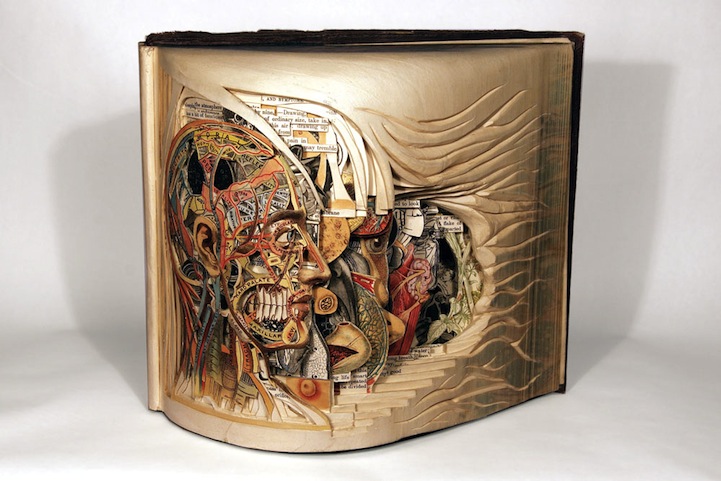
This is one of the many examples of the Book Surgeon’s art.

I came across this picture (one example of many by the artist) via social networks on the art of “The Book Surgeon.”  It reminded me of a great thought from Marshal McLuhan: If it works, it is obsolete and if the obsolete still works, it becomes an “art form.”  (McLuhan via Duggan in “Zuckerberg Galaxy“)

With the rise of ebooks, the old Guttenberg technology of mass published books has been usurped by the rising tide of the exponentially democratized ebook era.  Personally, I was wary of ebooks but after using them for almost a year, I now prefer them (they are, in my experience, faster to read, easier to carry, convenient to reference, and my notes are instantly accessible).  I know others prefer the tactile feel of paper books, but even they have to admit that their preference is based on a nostalgic experience that won’t be equally held by future generations.  We have entered what Len Sweet calls the TGIF era (Twitter, Google, Iphone and Facebook –  I would just add Kindle to the list but that would throw-off his great acronym) and the speed of change and its impact are exponentially growing.

Ebooks and the technology it represents, are changing culture.  As prophetically warned by Marshall McLuhan:  “Art at its most significant is a distant early warning system that can always be relied on to tell the old culture what is beginning to happen.”